
Ta strona nie jest jeszcze dostępna w Twoim języku. Wyświetlamy wersję angielską.
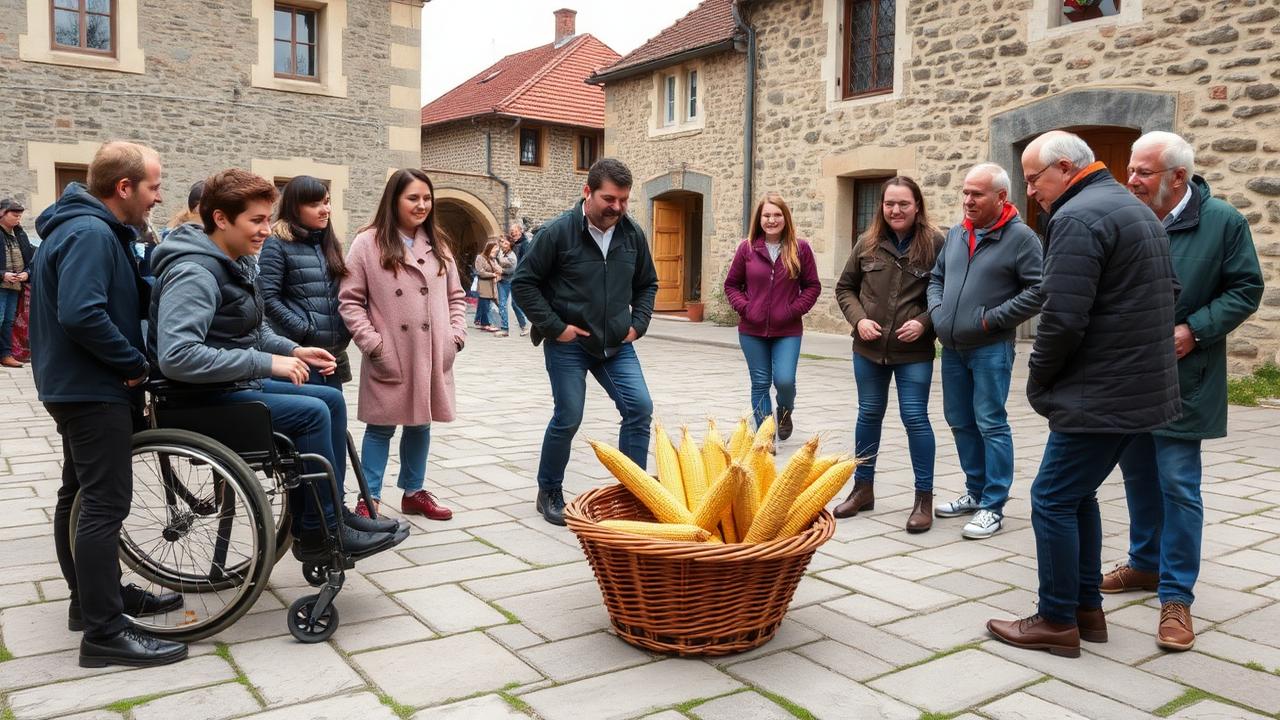
A precision throwing game: players stand behind a line and throw discs or small balls at a table-like structure, aiming above all for the mouth of the metal frog, which scores highest.
Kontekst kulturowy
La rana is one of the most widespread traditional square and tavern games in Spain, played in Castilla, the Basque Country, Asturias and beyond, usually by adults at cider houses and local festivals. It is a game of the everyday, played standing, talking and taking turns — the social frame matters as much as the score.
Jak grać
1. Place the frog table 3–4 m from the throwing line (shorter for younger or beginner groups).
2. Each player throws all discs in turn, one at a time.
3. Scoring: the frog's mouth scores the most points, the bridges and holes score less, the table surface scores least, and a miss scores nothing.
4. A player must keep both feet behind the line while throwing.
5. Players add up their points after each round; play a fixed number of rounds or to an agreed total.
Adaptacje włączające
DRAFT FOR PARTNER REVIEW — this text was written by the coordination team and must be validated by the partner that contributed the game.
Reduced mobility and disability
Distance is the main adjustment: set a personal throwing line for each participant so everyone scores regularly, marked with coloured tape rather than announced aloud. Seated players throw from a wheelchair or chair at the same personal distance; lower the frog table on adjustable legs or a crate so the mouth is at a comfortable height. For limited grip, use light foam balls or a ramp the player aims and releases from. Partner-assisted throwing is valid as long as the player chooses the aim and gives the release signal. Blind and partially sighted players are guided by a bell behind the target and by touching the target layout before the round.
Multilingual groups and newcomers
Introduce the game without words first: the facilitator plays one full round while the group watches, then a second round in slow motion naming only three or four key words in the local language. Print the key words on cards with a simple drawing (start, go, stop, your turn, point) and keep them visible. Pair each newcomer with a peer buddy for the first two rounds; the buddy demonstrates rather than translates. Never let understanding the rules become a condition for joining — anyone can enter mid-round.
Mixed-gender and mixed-age groups
Build mixed teams by drawing lots, never by letting captains pick. Guarantee that every participant takes the same number of active turns and rotate every role — including the visible, decisive ones — so that scoring, throwing or leading is not monopolised by the most confident or the oldest players. Watch for symbolic participation: a turn that nobody watches or that cannot affect the result is not participation. When ages or body sizes differ widely, adjust distances or scoring per player rather than creating a separate 'easy' group.
Uwagi dotyczące bezpieczeństwa
DRAFT FOR PARTNER REVIEW — this text was written by the coordination team and must be validated by the partner that contributed the game.
Metal discs are heavy: keep everyone behind the throwing line, never allow anyone to collect discs while a round is running, and appoint one person to call "clear" before collection. Play on a surface where discs do not bounce back unpredictably and add a soft backstop behind the target. Use rubber or foam discs with younger groups and indoors. Check that the target structure is stable and cannot tip.
Efekty uczenia się
DRAFT FOR PARTNER REVIEW — this text was written by the coordination team and must be validated by the partner that contributed the game.
Participants improve hand–eye coordination, aiming, force control and mental arithmetic through scoring. The game creates natural conversation and turn taking, which makes it a strong tool for group building and intergenerational sessions. It also demonstrates the inclusion principle most clearly: with individual throwing lines a mixed-ability group can compete honestly on a single shared score.
Na tej stronie
- Kraj pochodzenia
- Spain
- Kategoria
- Game
- Wiek uczestników
- 13–30
- Intensywność fizyczna
- Low
- Obszar włączania
- Mixed
- Materiały
- Frog target structure with open mouth and scoring holes, 8–10 small discs or balls, throwing line marked on the ground