

Ta strona nie jest jeszcze dostępna w Twoim języku. Wyświetlamy wersję angielską.
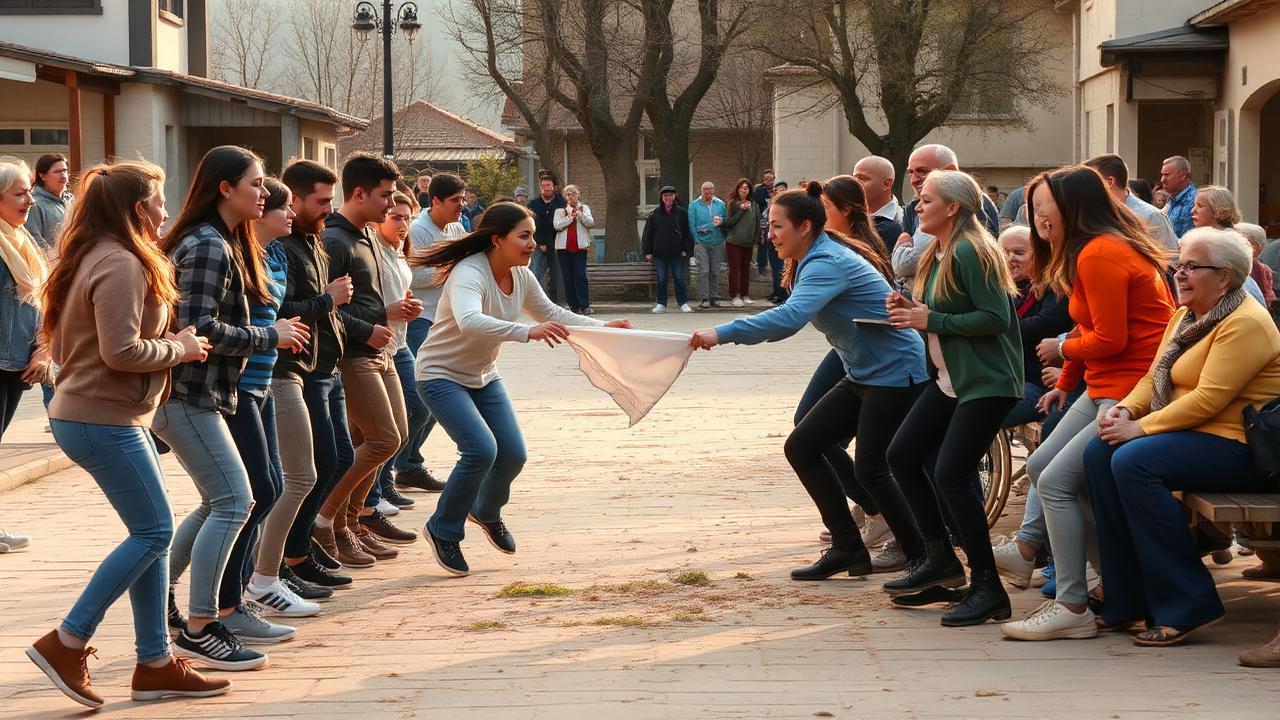
A team version of Turkish "burn ball": the field is divided by a centre line, each team stays in its half, passes among its own players and tries to hit opponents with the ball, either directly or after a bounce, depending on the agreed rule.
Kontekst kulturowy
Yakan Top is played all over Türkiye in schoolyards and neighbourhood streets; the "kaleli" (with a goal) variant adds a target zone, which turns a pure elimination game into a game of collective positioning. It is the Turkish member of the large European family of hitting-and-dodging games.
Jak grać
1. Divide the field with a centre line and mark a goal zone at each end.
2. Two teams take one half each; players must stay in their own half.
3. Players pass the ball among their team mates to create an opening.
4. A player throws to hit an opponent below the waist. Depending on the agreed variant, only direct hits count, or hits after one bounce also count.
5. A hit player leaves the field or moves to the goal zone behind the opposing team, from where they can still receive passes and throw.
6. If a player catches a throw cleanly, the thrower is out instead.
7. The round ends when one team has no players left in its half.
Adaptacje włączające
DRAFT FOR PARTNER REVIEW — this text was written by the coordination team and must be validated by the partner that contributed the game.
Reduced mobility and disability
Use a soft foam or fabric ball at all times and keep the rule that hits must be below the waist. Seated players and wheelchair users play in a protected zone closer to the centre line where they receive and throw more often, and cannot be targeted from closer than 4 m. A no-elimination variant keeps everyone playing: a hit scores a point for the opponents and the player continues, so nobody spends the game watching. Participants with limited throwing strength get a designated pass-and-position role plus a shorter throwing distance. Blind and partially sighted players use a ball with a bell, a fixed lane position and a caller.
Multilingual groups and newcomers
Introduce the game without words first: the facilitator plays one full round while the group watches, then a second round in slow motion naming only three or four key words in the local language. Print the key words on cards with a simple drawing (start, go, stop, your turn, point) and keep them visible. Pair each newcomer with a peer buddy for the first two rounds; the buddy demonstrates rather than translates. Never let understanding the rules become a condition for joining — anyone can enter mid-round.
Mixed-gender and mixed-age groups
Build mixed teams by drawing lots, never by letting captains pick. Guarantee that every participant takes the same number of active turns and rotate every role — including the visible, decisive ones — so that scoring, throwing or leading is not monopolised by the most confident or the oldest players. Watch for symbolic participation: a turn that nobody watches or that cannot affect the result is not participation. When ages or body sizes differ widely, adjust distances or scoring per player rather than creating a separate 'easy' group.
Uwagi dotyczące bezpieczeństwa
DRAFT FOR PARTNER REVIEW — this text was written by the coordination team and must be validated by the partner that contributed the game.
Only soft balls: never a leather or hard inflated ball. Hits to the head, face or groin do not count and stop the round. Set a minimum throwing distance of 3–4 m and forbid throwing at a player who is not looking. Keep the sidelines free of obstacles and check that the goal zones are not against a wall. Remind players that maximum force is not the objective — accuracy is.
Efekty uczenia się
DRAFT FOR PARTNER REVIEW — this text was written by the coordination team and must be validated by the partner that contributed the game.
Participants develop throwing accuracy, dodging agility, spatial awareness and team communication. The no-elimination variant turns the classic weakness of dodgeball — the least confident players are removed first — into its opposite: everyone plays for the whole round. The game is a good setting for discussing consent, force control and how a rule change alters who enjoys the game.
Na tej stronie
- Kraj pochodzenia
- Türkiye
- Kategoria
- Game
- Wiek uczestników
- 13–30
- Intensywność fizyczna
- Medium
- Obszar włączania
- Mixed
- Materiały
- One soft ball, cones or chalk for the centre line and the two goal zones, bibs for the two teams