

Ta strona nie jest jeszcze dostępna w Twoim języku. Wyświetlamy wersję angielską.
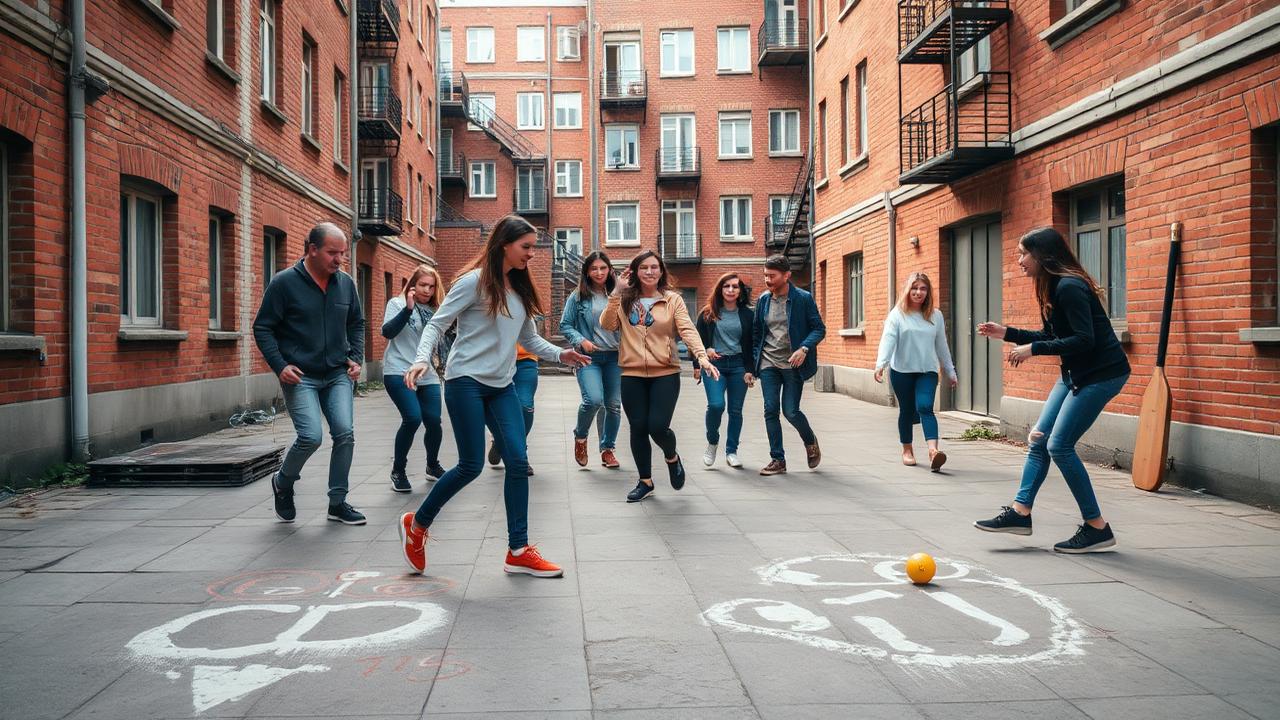
Players throw a marker into a numbered square drawn on the ground and travel through the grid according to the rules of the chosen variant, hopping, stepping or moving without touching the lines.
Kontekst kulturowy
Gra w klasy is one of the most widespread children's games in Poland and across Europe, drawn in chalk on pavements, courtyards and school playgrounds. Dozens of grid shapes and rule variants exist from region to region, and the game passes directly from child to child without any adult organisation — a pure example of living intangible heritage.
Jak grać
1. Draw the grid: a classic layout is squares 1 to 8, with single and double squares alternating.
2. The first player throws their marker into square 1.
3. The player travels through the grid, skipping the square containing the marker: one foot in single squares, two feet in double squares.
4. At the end of the grid the player turns and comes back, picking up the marker on the way.
5. A turn ends if the player steps on a line, loses balance or puts a foot down where they should not; the next player goes.
6. On the next turn the player throws to the following number. The winner is the first to complete all the numbers.
Adaptacje włączające
DRAFT FOR PARTNER REVIEW — this text was written by the coordination team and must be validated by the partner that contributed the game.
Reduced mobility and disability
Change the movement, keep the grid: allow walking, stepping, using a walking aid or wheeling through the squares instead of hopping, and announce these as equal options at the start rather than as concessions. Enlarge the squares so a wheelchair or walker fits and draw the grid on a smooth indoor floor with tape. Players who cannot travel the grid play a table-top version with a hand-drawn grid and a token, or take the throwing phase while a partner travels the grid on their instruction. Balance-impaired players may hold a partner's hand or a rail. Blind and partially sighted players use a grid outlined in textured tape and a caller.
Multilingual groups and newcomers
Introduce the game without words first: the facilitator plays one full round while the group watches, then a second round in slow motion naming only three or four key words in the local language. Print the key words on cards with a simple drawing (start, go, stop, your turn, point) and keep them visible. Pair each newcomer with a peer buddy for the first two rounds; the buddy demonstrates rather than translates. Never let understanding the rules become a condition for joining — anyone can enter mid-round.
Mixed-gender and mixed-age groups
Build mixed teams by drawing lots, never by letting captains pick. Guarantee that every participant takes the same number of active turns and rotate every role — including the visible, decisive ones — so that scoring, throwing or leading is not monopolised by the most confident or the oldest players. Watch for symbolic participation: a turn that nobody watches or that cannot affect the result is not participation. When ages or body sizes differ widely, adjust distances or scoring per player rather than creating a separate 'easy' group.
Uwagi dotyczące bezpieczeństwa
DRAFT FOR PARTNER REVIEW — this text was written by the coordination team and must be validated by the partner that contributed the game.
Choose a flat, dry, non-slip surface with nothing hard within two metres of the grid. Hopping loads ankles and knees, so warm up and keep turns short. Do not play in slippery shoes or in socks on smooth floors. For participants with balance difficulties, place a partner alongside for the whole run rather than only at the difficult squares. Chalk grids on a slope or near steps are not acceptable.
Efekty uczenia się
DRAFT FOR PARTNER REVIEW — this text was written by the coordination team and must be validated by the partner that contributed the game.
Participants develop balance, single-leg strength, rhythm, sequencing and number recognition. Because every European participant recognises some version of the game, it is a fast way to build a shared reference in an intercultural group and to compare local variants. The rule that movement mode is free — hop, step or wheel — is the clearest demonstration of universal design in the whole I-PLAY collection.
Na tej stronie
- Kraj pochodzenia
- Poland
- Kategoria
- Game
- Wiek uczestników
- 13–30
- Intensywność fizyczna
- Medium
- Obszar włączania
- Mixed
- Materiały
- Chalk or floor tape, one small marker or token per player, flat non-slip surface